
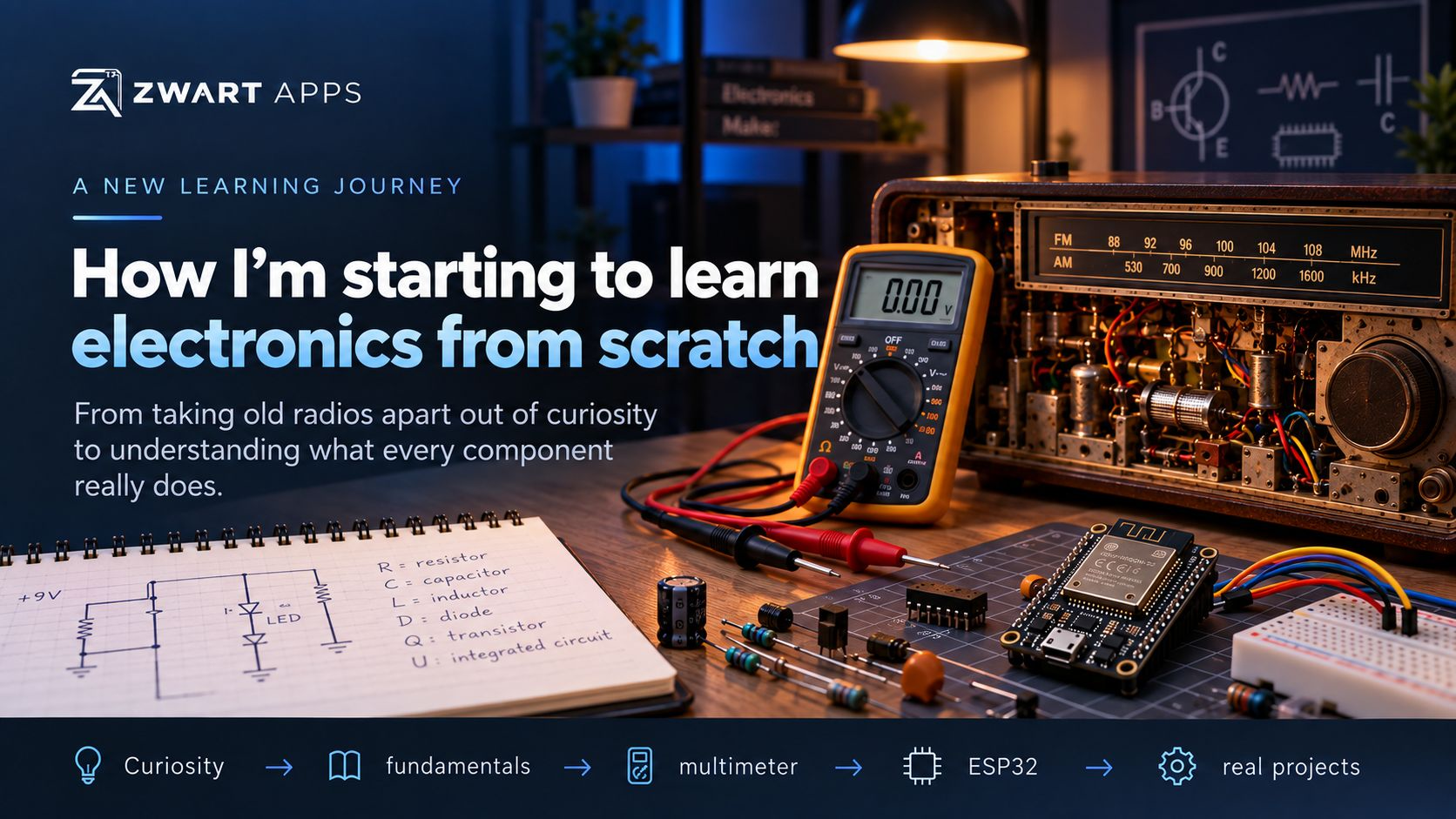
Electronics has fascinated me for as long as I can remember. Long before I started working as a software developer, I was already curious about what was hiding inside everyday devices. As a kid I used to take old radios apart, open broken gadgets and turn a table into a collection of screws, wires and mysterious components.
Back then I had no idea what a resistor, capacitor or transistor actually did. I simply played with the parts, tried to guess their purpose and, quite often, proved much better at taking things apart than putting them back together. That curiosity never really disappeared.
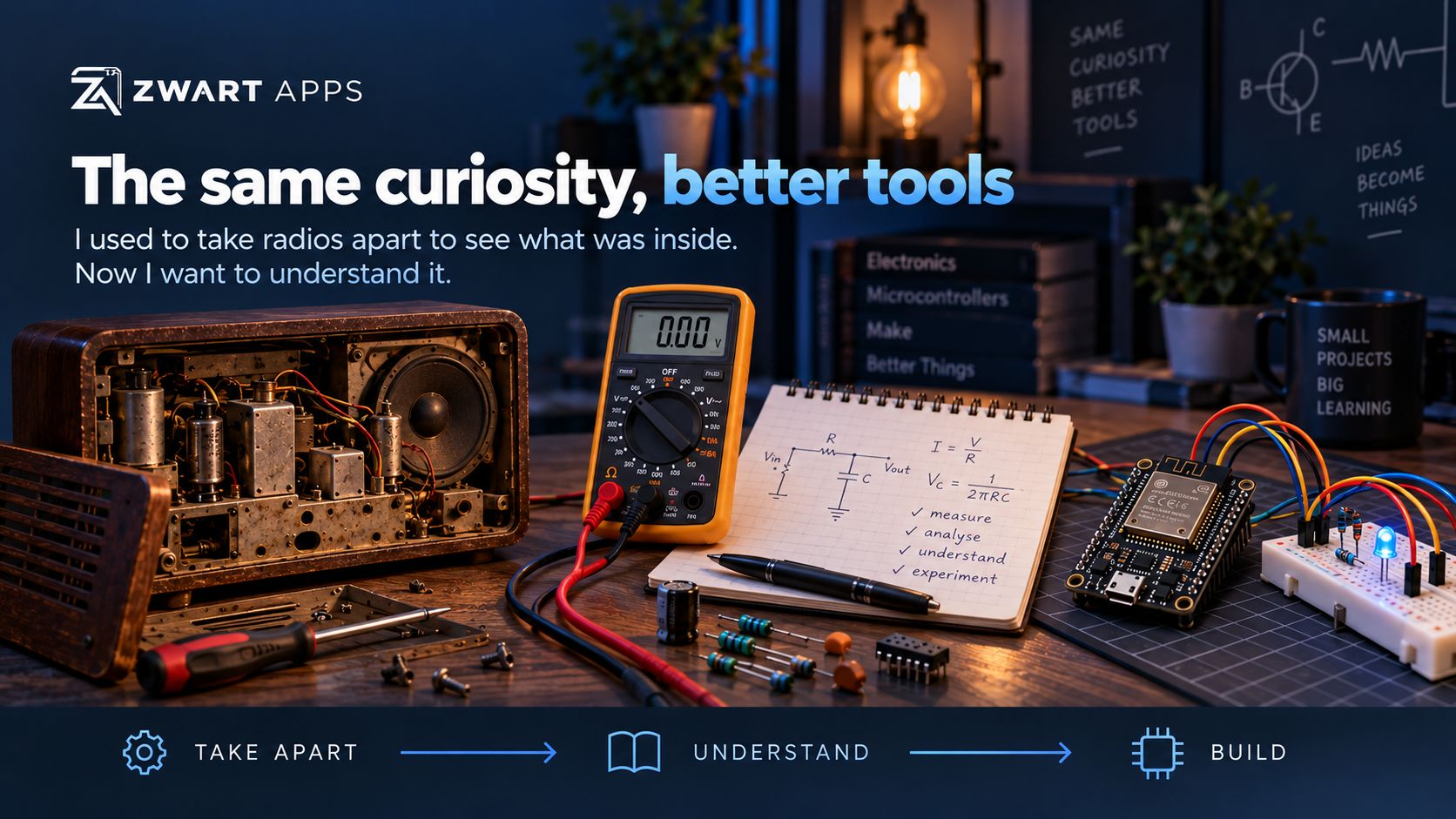
Returning to something that always interested me
Eventually my path took me toward computing and software development. Programming lets us build an enormous range of things, but most of my work has happened at a level where the hardware is already assumed to work. We write code, use operating systems and connect services while a physical machine underneath quietly makes everything possible.
Now I want to move one layer lower and understand more of what is happening physically. What a resistor is really doing in a circuit, why an LED needs current limiting, how a transistor is used, what a multimeter is actually measuring, and what happens electrically when a board such as an ESP32 reads a sensor and runs some code.
This time I want to understand what I’m doing
My goal is not to start with spectacular projects. I also do not want to buy a pile of modules, copy a circuit from the Internet and celebrate when it works without knowing why.
I want to begin with the fundamentals: voltage, current, resistance, Ohm’s law, series and parallel circuits, basic components and the correct use of measurement tools. These may be elementary concepts to someone experienced in electronics, but that is exactly the point of this project for me: start at the beginning and document the process without pretending I already know the answer.
Software development has taught me many times that understanding a simple foundation properly saves hours of confusion later. I want to apply the same idea to electronics.
From a screwdriver to a multimeter
When I was a kid, my main tool was basically a screwdriver. Opening an old radio was enough to make it fascinating: circuit boards, wires, speakers, potentiometers and colourful components I could not identify.
Now I want to recreate some of that feeling with a little more method. I want to identify components, measure them, see how they behave and understand how they interact inside a circuit. A multimeter will probably be one of my first important tools, along with a breadboard, jumper wires, resistors, LEDs and a simple power source.
Soldering will come later too. Not only because I want to learn how to solder properly, but because I would like to repair small devices, replace components and build projects that do not have to live forever on a breadboard.
ESP32 as a bridge between software and electronics
One reason this feels like such a good time to start is how accessible development boards have become. I want to use ESP32 because it connects two worlds I find especially interesting: programming and electronics.
I can begin with something as simple as blinking an LED and gradually move on to buttons, sensors, displays, motors and Wi-Fi or Bluetooth connections. Part of the environment already feels familiar because of my programming background, while every project forces me to learn something new about the physical circuit.
I also want to avoid relying entirely on libraries that hide everything happening underneath. I will use them when they make sense, but I first want to understand what signal I am sending, what voltage a component expects and what is happening between the board and the connected device.
Learning by breaking things, only a little more carefully
There will almost certainly be mistakes: LEDs connected backwards, badly chosen resistor values, circuits that do absolutely nothing and components that cost me half an afternoon before I discover the problem was one wire.
That is also part of what attracts me to electronics. When something does not work, you have to measure, inspect and reason through the problem. It feels a lot like debugging software, except this time the bug may literally be sitting on the table in front of me.
That is the process I want to document. Not just the final working circuit, but the questions, tests and mistakes along the way. For someone else starting out, seeing the real process may be more useful than only seeing a perfect diagram at the end.
What I’m starting with
For this first stage I ordered three very specific things: a book to give me a structured theoretical base and practical exercises, a multimeter so I can learn to measure what is actually happening, and an ESP32 starter kit so I can quickly move from theory to small circuits and projects.
Disclosure: some of the links below are affiliate links. If you buy through them, Zwart Apps may receive a small commission at no additional cost to you.
Book
Complete Electronics Self-Teaching Guide with Projects
I will use it as a structured companion for learning the fundamentals through exercises and practical projects.
View the book on Amazon →
Multimeter
My first multimeter
It will be one of the core tools in the learning process: measuring voltage and resistance, checking continuity and seeing what is actually happening in each circuit.
View the multimeter on AliExpress →
ESP32 Starter Kit
ESP32 starter kit
This will bridge the programming I already know with the new physical side: LEDs, buttons, sensors and small hardware builds.
View the starter kit on AliExpress →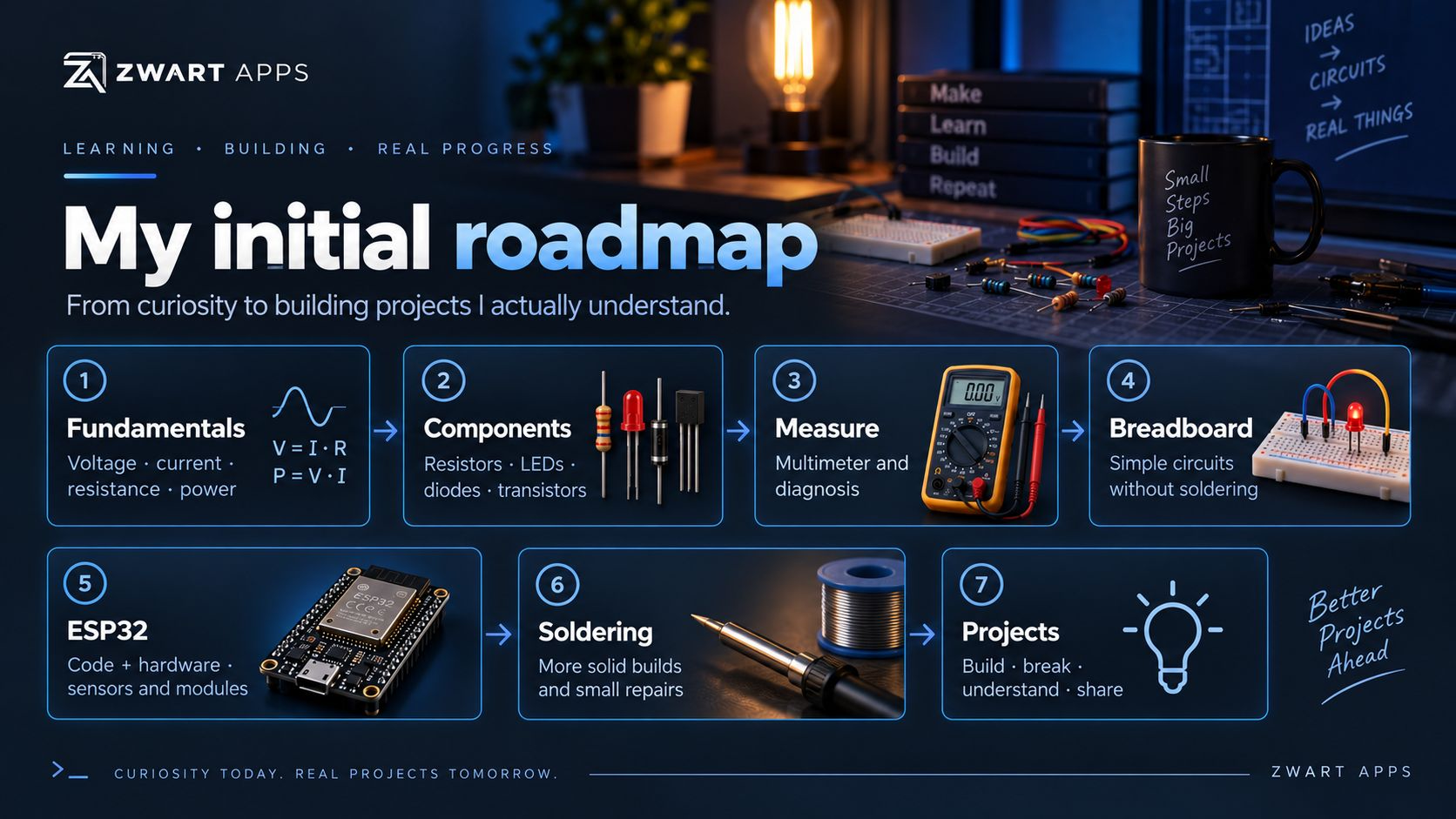
My initial roadmap
- Learn the basics of voltage, current, resistance and power.
- Understand and recognise resistors, capacitors, diodes, LEDs and transistors.
- Learn to use a multimeter properly.
- Build simple circuits on a breadboard.
- Start using ESP32 and connect code to real components.
- Learn basic soldering and good practices.
- Build small projects and document both successes and mistakes.
Playing again, but learning this time
In a way, this feels like returning to something that started many years ago. The difference is that now I do not just want to take a radio apart to see what is inside. I want to understand why those parts are there and what each of them actually does.
That will be the idea behind this new part of Zwart Apps: learn electronics from scratch, gradually connect it with programming and share the journey as it happens.
Build. Learn. Share.